
Low risk
A flatter set of multipliers. Most slots pay somewhere between part of your bet and a small multiple of it; edge slots pay modestly. The balance moves slowly.
Plinko is a Stake Original: a ball drops through rows of pegs and lands on a multiplier, and every result can be verified independently. This guide explains the 8 to 16 rows, low, medium and high risk, the 1% house edge and how auto mode works. Play Plinko on Stake with a fixed budget, and every drop also moves you up the $100,000 Daily Races leaderboard, one of the Stake bonuses open to every player.
Current Stake promotions: Weekly Raffle $75,000 · Daily Races $100,000 · Wheel Wars $150,000 a month
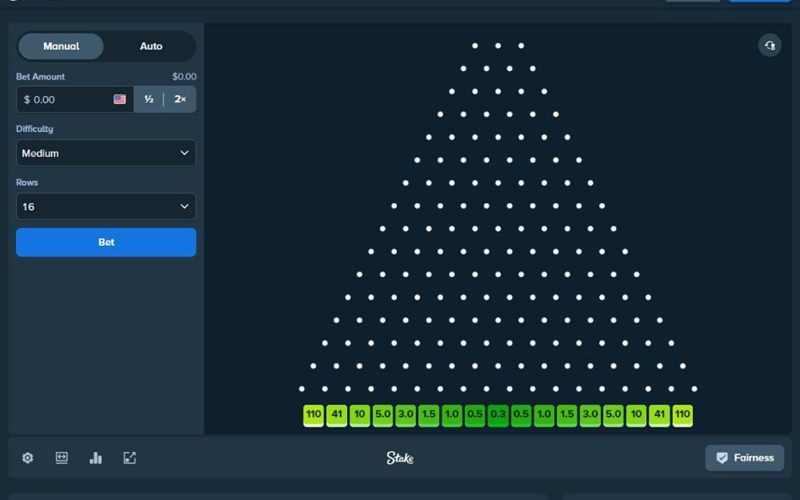
Plinko takes seconds to learn. You set a bet, choose the number of rows and a risk level, and drop a ball. At every peg the ball goes left or right with equal probability. The slot it lands in at the bottom decides your payout: bet × the slot's multiplier.
| Developer | Stake (Stake Original) |
|---|---|
| Rows | 8 to 16 |
| Risk levels | Low, Medium, High |
| House edge | ~1% (RTP ~99%) |
| Modes | Manual and Auto |
| Fairness | Provably fair (server seed, client seed, nonce) |
With n rows there are n + 1 slots at the bottom. Because each bounce is a 50/50 coin flip, the ball most often ends up near the middle and only rarely at the edges — the classic bell-shaped distribution.
| Rows | Slots | Chance of the centre slot | Chance of one edge slot |
|---|---|---|---|
| 8 | 9 | ~27% | 1 in 256 |
| 12 | 13 | ~23% | 1 in 4,096 |
| 16 | 17 | ~20% | 1 in 65,536 |
Theoretical probabilities from the 50/50 bounce model, shown for illustration.
More rows make the edge slots much rarer, which is why Stake can print larger multipliers on them. Fewer rows give a tighter, more predictable spread.
The risk setting does not change where the ball goes — it changes what each slot pays. All three levels keep the same ~99% long-run return; they only redistribute it. By comparison, popular Stake slots such as Sweet Bonanza publish an RTP of about 96.51%.
A flatter set of multipliers. Most slots pay somewhere between part of your bet and a small multiple of it; edge slots pay modestly. The balance moves slowly.
Middle slots pay less than your bet, edge slots noticeably more. Losing drops are more common, with occasional bigger hits.
Middle slots return only a fraction of the bet, while the outer slots carry the largest multipliers. Most drops lose money; rare edge hits pay a lot.
Combine both settings and you get the variance you are signing up for: 8 rows + low risk is the calmest version of the game, 16 rows + high risk the wildest, where the biggest multipliers sit in slots that are hit roughly once in tens of thousands of drops. The exact multipliers for every combination are shown on the board before you bet. Stake Mines offers a similar trade-off between risk settings and multipliers.
Tip: a ball landing next to the edge does not mean the edge is "close". Every drop is independent, and the odds are the same on the next ball.
An illustrative comparison helps show why settings matter more than any "trick". Imagine 100 drops of ₹10 each — ₹1,000 wagered in total.
| Setting | Typical experience | Long-run expected cost |
|---|---|---|
| 8 rows, low risk | Balance drifts slowly; most drops return part of the bet or a little more | About ₹10 |
| 12 rows, medium risk | Long stretches of small losses broken by occasional larger wins | About ₹10 |
| 16 rows, high risk | Most drops lose most of the bet; an edge hit is possible but very unlikely in only 100 drops | About ₹10 |
Expected cost = 1% of ₹1,000 wagered. Actual results in a 100-drop session can be far above or below this figure.
In other words, high-risk Plinko is not "more profitable" — it simply makes the outcome of a short session far less predictable. A short high-risk session usually ends with a loss bigger than ₹10, and only occasionally with a large win. The same logic applies to crash games such as Aviator: a higher target multiplier means rarer wins, not a better return.
Each drop's path — the sequence of left and right bounces — is calculated from your client seed, Stake's server seed and the bet's nonce. The server seed is committed in advance as a hash. After rotating your seed pair, the unhashed server seed is revealed and you can recalculate any drop with Stake's verifier or an independent tool; the path and slot must match the result you received. See our Stake casino guide for the step-by-step explanation of seeds and nonces.
Auto mode drops balls continuously with your chosen settings. You can set the number of bets, adjust the bet on win or loss and, most importantly, define stop-on-profit and stop-on-loss limits.
Plinko is entertainment with a ~1% cost per bet over time, not a source of income. If it stops being fun, stop playing — our responsible gaming page lists where to get support.
None is better in the long run — every combination of rows and risk has roughly the same ~99% RTP. Settings only change how volatile the results are.
Between 8 and 16. More rows mean more slots and rarer, higher-paying edge results.
The ball lands in the middle most often. To fund higher multipliers at the edges, the middle slots on medium and high risk return less than the stake.
Plinko is provably fair: each drop is determined by seeds and a nonce that you can verify after rotating your seed pair. Our Stake licence page explains how fairness checks and account security work.
Stake Originals, including Plinko, can usually be played in demo mode with virtual credit.